
The complete guide
How to Choose and Style a Pair of Ceramic Vases
The problem with a bare surface
Most homes have at least one surface that never quite looks right. A console by the front door. The middle shelf of a bookcase. The end of a sideboard. The furniture is fine, the wall is fine, but the space reads unfinished, like a sentence missing its last word.
The usual fix is to pile on objects. Candles, trays, small frames, a bowl of something. More often than not this just moves the problem along, because a cluster of small items at the same low height makes a surface look busy and flat at the same time.
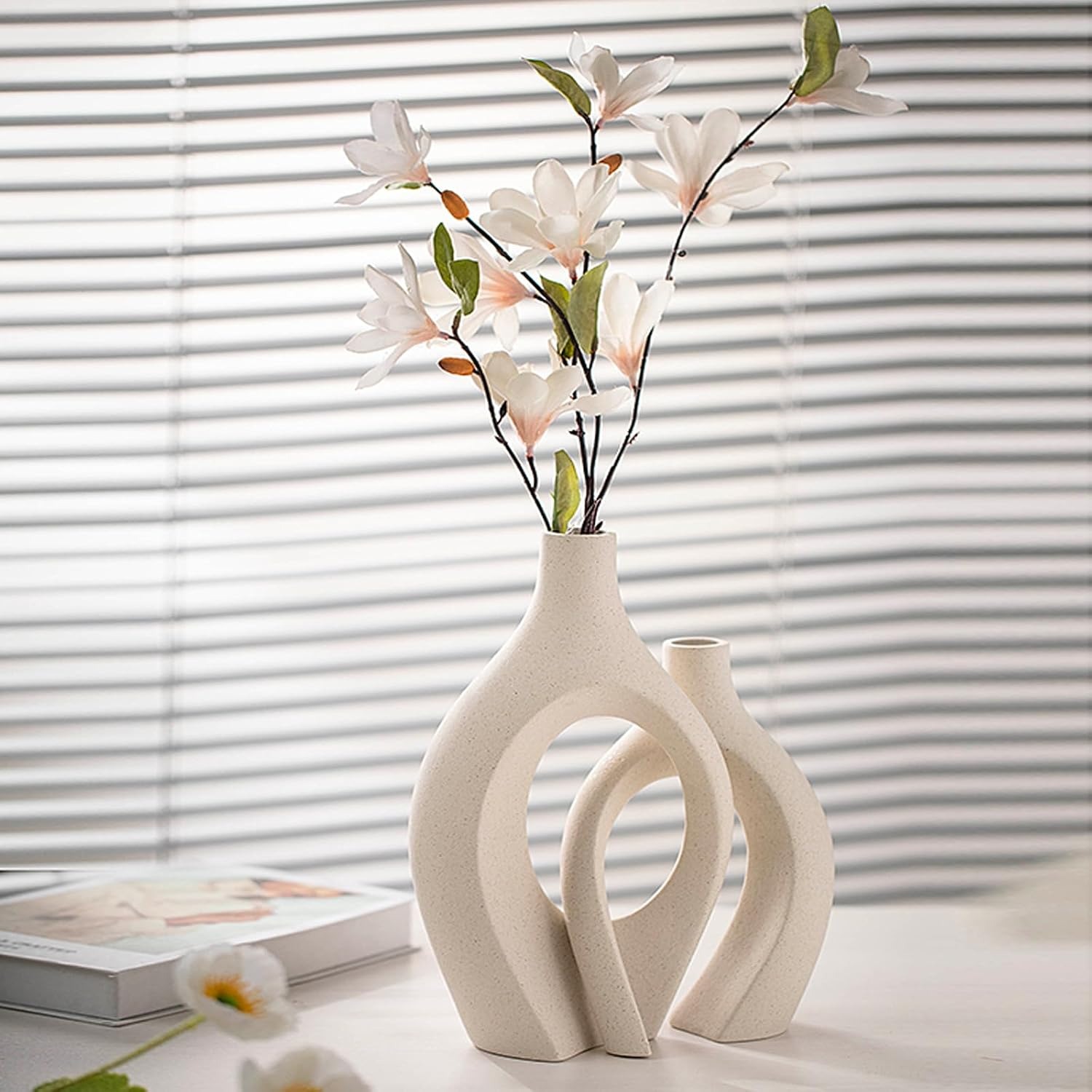
What these surfaces usually need is height and one strong shape. That is the job a good vase does, and it is why a pair of beige hollow ceramic vases can tidy up a room faster than another round of rearranging.
How a hollow vase actually works
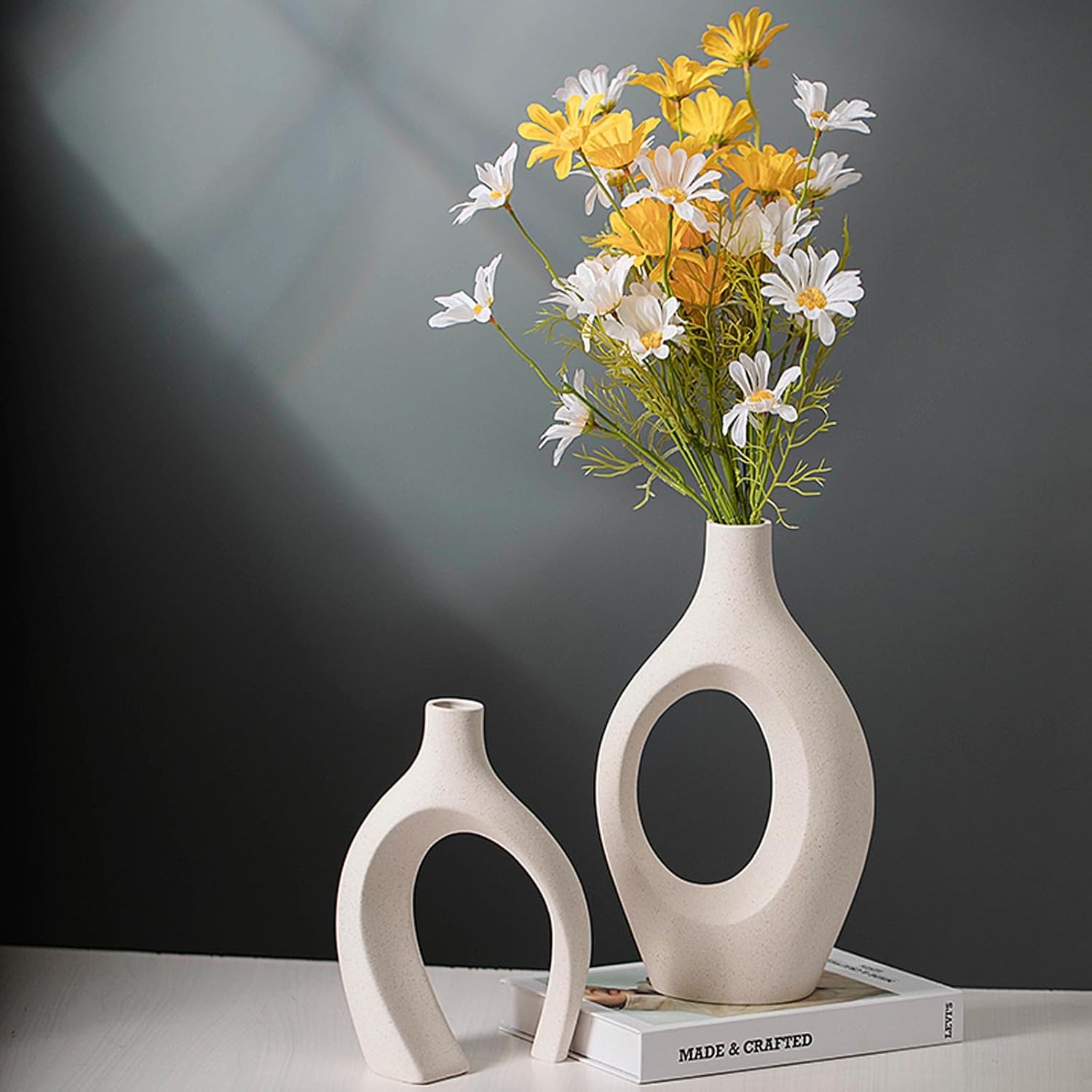
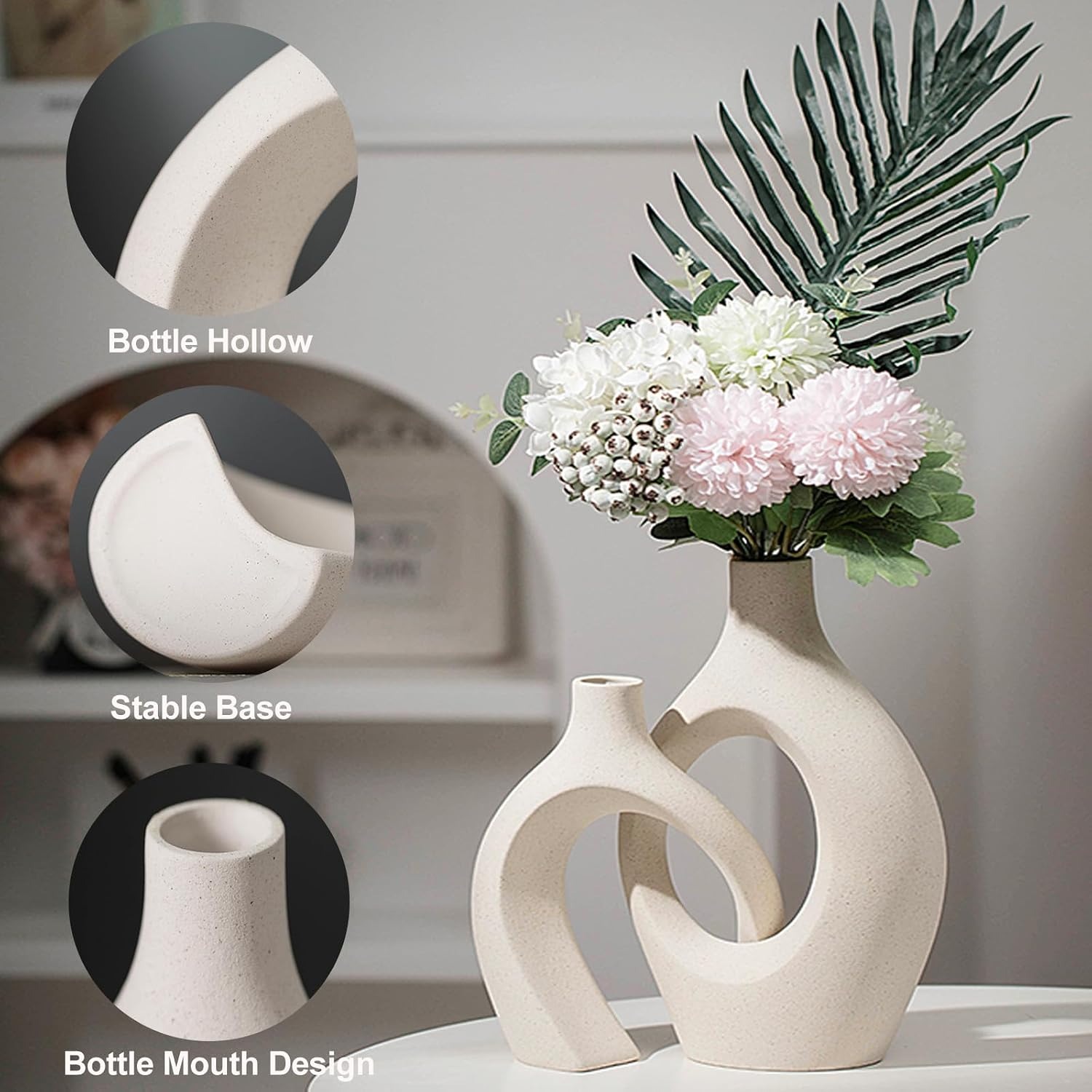
The hollow centre is the point of difference here. Each vase has a hole through the middle of the body, so instead of a solid block you get an outline. Light passes through the gap, the wall behind shows through, and the object reads as a shape rather than a lump.
That matters when the vase is empty, which, if we are honest, is most of the time. A plain cylinder with nothing in it looks like it is waiting. A shape with a void in it looks intentional. You can leave these two sitting on a shelf for a month without flowers and the shelf still looks styled.
The photos show a narrow round neck at the top of each vase. You put a few stems in and they stand together. The hollow part is below that, in the body, so it does not interfere with how you use the vase.
The other half of the equation is the finish. These are ceramic with a matt surface, which changes how they look in a room far more than people expect. Glossy ceramic throws a bright highlight wherever light hits it, so a single vase can end up with three competing shiny spots from a window, a ceiling light and a lamp. Matt beige absorbs that light instead. The colour stays even across the whole body, the curve reads clearly, and the piece looks calm rather than shouty.
Who these suit
They suit anyone decorating a neutral room who does not want to commit to a colour. Beige works beside white walls, cream sofas, timber, rattan, black metal frames and almost any grey. It is the easiest of the neutrals to place.
They suit people who like plants but kill them. Dried stems, preserved foliage and good quality faux branches look right in a narrow-necked vase, and none of them need water, light or attention. In an air-conditioned flat where the humidity swings every time you open a door, dried arrangements hold their shape for months.
They suit anyone who wants a gift that is not a gamble. The maker names baby showers and birthdays as occasions, and a neutral ceramic pair is a sensible housewarming present because it does not fight whatever colour scheme the recipient already has.
They are less suited to someone who wants a single statement piece in a bold colour, or who needs something small and low for a tight surface. At the published size of 17.3 x 14.3 x 28.3 cm, these have real presence.
How to choose and place them
Start with height. The maker gives a single size of 17.3 x 14.3 x 28.3 cm for the set. That puts them in large decorative territory. On a low coffee table they will read as the main feature, so keep whatever else is on the table small and flat. On a tall bookshelf they fill vertical space properly, which is the whole reason shelves so often look empty even when they are full of books.
Then think about the pair. Two objects give you choices a single vase cannot. Here are the arrangements that work most reliably.
Side by side as a close pair, slightly offset rather than perfectly aligned. This is the easy win on a console or sideboard. Offset them a few centimetres forward and back so they do not look like bookends.
Split across one room. One on the coffee table, one on the shelf behind the sofa. The repeated shape ties the two zones together, which is a trick stylists use constantly.
Split across two rooms. Living room and bedroom, or home and office. Since the pair arrives together, you are effectively getting two placements from one purchase.
Grouped with something of a different height. A pair plus a low bowl or a stack of books reads better than three items all the same height. Vary the levels and the group looks composed.
Next, think about what goes in them, if anything. For a balanced look, stems about one and a half times the height of the vase usually land well. Taller than that and the arrangement can look top heavy. Shorter and the vase swallows it. Pampas grass, dried wheat, preserved eucalyptus and bleached branches all suit a narrow neck, a few stems at a time. The maker says fresh flowers can go in too.
Finally, think about the backdrop. A matt beige vase against a white wall reads as soft and quiet. Against a dark wall or a timber panel it stands out sharply. Neither is wrong, but it is worth holding the pair up in the spot before you commit, because the same object can look restrained in one corner and bold in another.
Living with ceramic
Ceramic is easy to look after and easy to break, which about sums up the whole relationship.
For the outside, a soft dry cloth handles dust. If something has marked the surface, use a barely damp cloth and nothing else. Keep abrasive pads, scouring powder and strong chemical cleaners away from a matt finish. Matt surfaces have a fine texture, and anything abrasive can polish away patches of it, leaving shiny spots that never match again.
For the inside, the enemy is standing water. If you use fresh flowers, change the water regularly and rinse the vase out when the arrangement is finished. A soft bottle brush gets into the base. Let it dry completely before you store it or refill it, because trapped moisture is what causes staining and smells over time.
Handling is the other thing. Lift rather than drag the vases across a hard surface, and use two hands. Keep them back from table edges where a passing elbow can catch them, and think twice before putting one on a narrow shelf in a walkway. If you have small children or an enthusiastic cat, a higher shelf or a deeper surface is the safer call.
If you ever need to store them, wrap each one separately rather than nesting them, and keep them upright in a box with something soft at the base.
The short version
A pair of beige hollow ceramic vases solves a common problem, which is a surface that looks unfinished no matter what you put on it. The hollow centre gives each piece a shape worth looking at even when empty, and the matt ceramic finish keeps the surface calm under changing light.
You get two, so you can group them, stagger them or split them between rooms. At the published size of 17.3 x 14.3 x 28.3 cm they have enough height to anchor a console, a sideboard or a shelf. Fill them with dried stems and forget about them, or use fresh flowers and rinse them out afterwards.
Beige, matt, oval, hollow, two of them. That is the whole offer, and for most neutral rooms it is enough.