
The complete guide
How to Choose and Burn a Eucalyptus Lavender Soy Candle
The problem with most candles in a small, closed room
Here is the usual story. You buy a candle, light it, and within ten minutes the room smells like a department store perfume counter. Or the opposite happens: you light it, wait, and smell almost nothing until you walk out and come back in. Neither is much fun.
A lot of that comes down to the match between the candle and the room. Flats and condominiums with the air conditioning running are a particular case. The air is cooler, drier and more enclosed than an open house, so scent does not disperse the way it would through a draughty room. A sweet, heavy fragrance that works outdoors or in a large open plan can feel cloying in a 12 square metre bedroom with the door shut.
That is the gap a green herbal scent fills. Eucalyptus and lavender together read fresh rather than rich. Eucalyptus brings the sharp note you recognise from a steam room, and lavender keeps it from tipping into something that smells like a pharmacy. In a cooled room the combination holds its shape instead of thickening as the evening goes on.
What you are actually buying
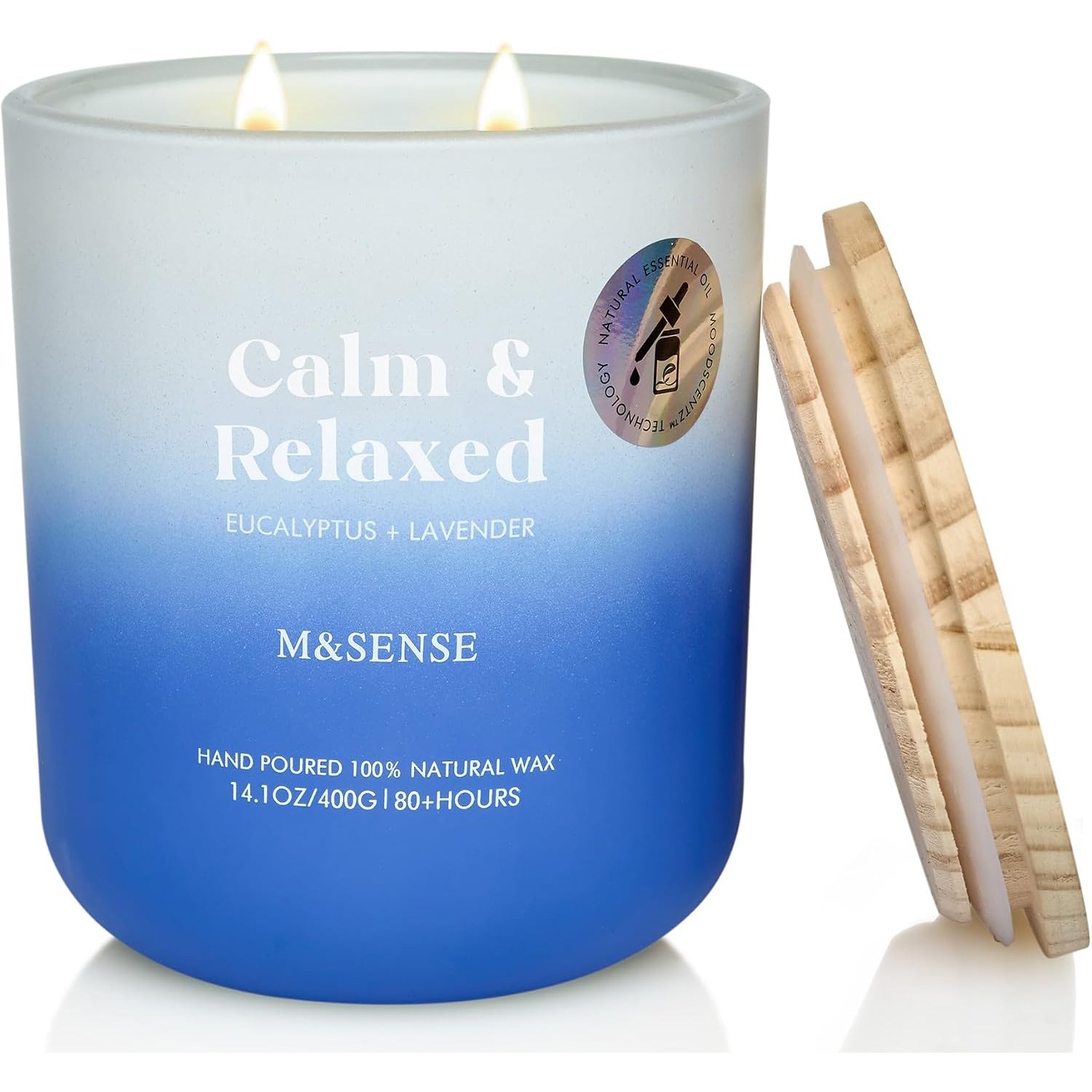
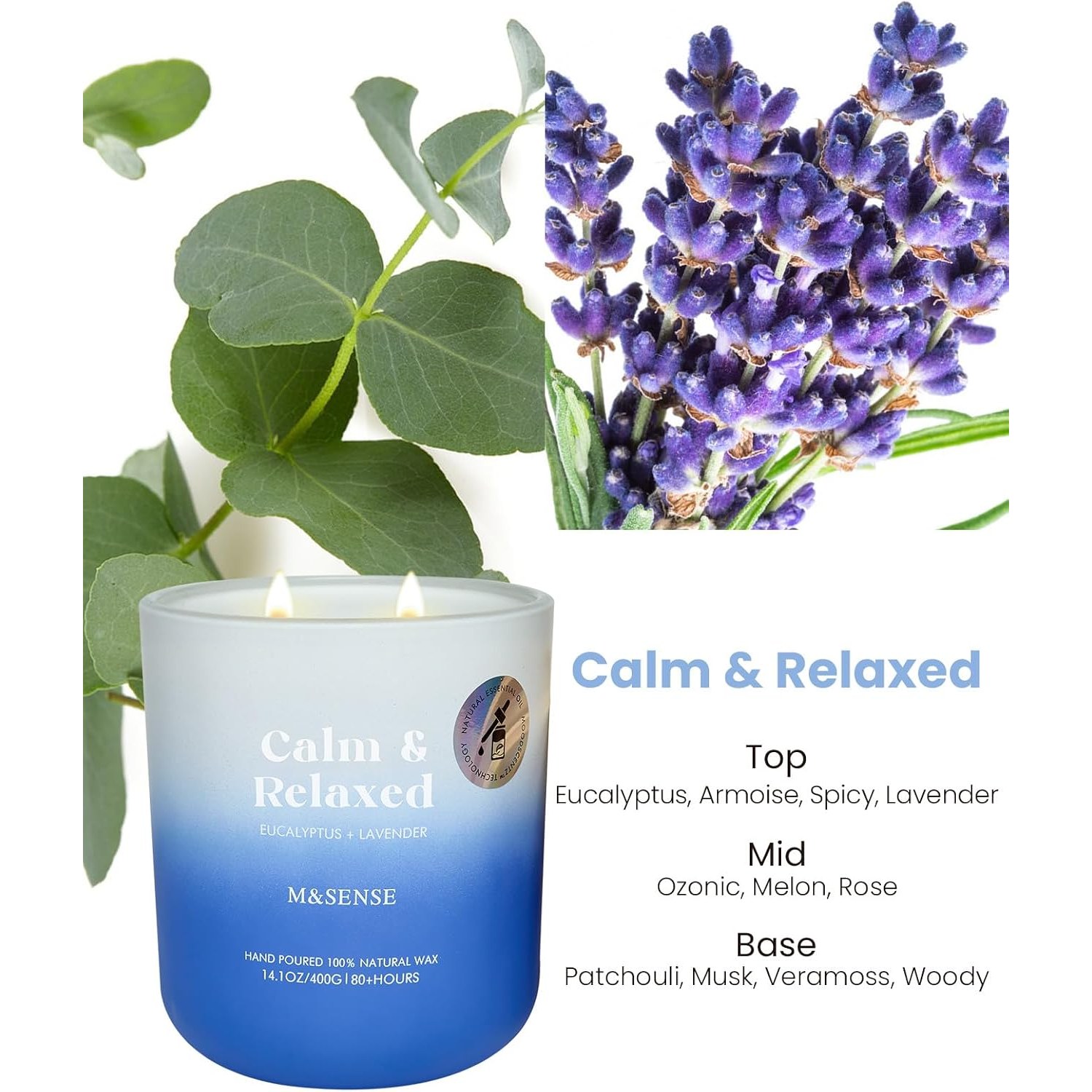
This is a 400 g container candle, which means the wax sits in the glass it burns in rather than being a free-standing pillar. The glass is 9 cm across and 11 cm tall, frosted, and shaded from white at the rim to blue at the base. The photos show two wicks and a wooden lid, although the maker's written details give a wick quantity of one. The wax is soy, and the maker states it is paraffin free.
The maker states a burn time of up to 80 hours. That is a maximum under good conditions, not a promise for every candle in every room, but it gives you a useful sense of scale. Compare a 400 g jar with a 100 g travel tin and the difference in size is clear.
What to expect from soy wax
Soy is a soft wax. In practice that means a few things you may notice.
The melt pool can take a while to reach the edge of the glass, which is why the first burn matters so much (more on that below). The scent also builds as the pool widens, so the room smells different after twenty minutes than it did at minute two.
Black smudges on the glass are almost always a wick problem rather than a wax problem, which is good news because the wick is the part you control. Keep it trimmed.
One last quirk: the surface of soy wax can develop a slightly frosted or crystalline look as it cools. The top may also dip a little around the wick. Both are cosmetic. Neither affects the burn or the scent.
Getting the first burn right
This is the single most useful thing to know about any container candle, and it is why some people think a candle is faulty when it is not.
Light it and leave it burning until the melted wax reaches the glass on every side. With a 9 cm candle that usually takes a few hours. Wax has a memory, and that first full pool sets the pattern for every burn after it. If you blow it out after forty minutes with a narrow pool in the middle, the candle will keep burning in that narrow channel, leaving a thick wall of wax you never get to use. That is tunnelling, and it is almost impossible to fully correct once it sets in.
So plan the first light for an evening when you are at home for a stretch. It is a small bit of patience that lets you use the full 400 g.
Keeping it burning well
After the first burn, the routine is simple.
Trim the wick to about 5 mm before each light. A long wick gives a tall, flickering flame, which burns hotter, produces more soot and gets through wax faster. Nail scissors do the job if you do not own a wick trimmer. Just pick the black burnt tip out of the wax afterwards.
Keep individual burns to roughly three to four hours. Beyond that the glass gets hot, the wick starts to mushroom at the tip, and you are more likely to see marks on the container. Put it out, let the wax set, and relight later if you want more.
Position matters more than people expect. Keep the candle away from the direct airflow of an air conditioning vent, a standing fan or an open window. Moving air drags the flame sideways, which burns one side of the wax faster than the other and leaves a lopsided pool. A stable, flat, heat-safe surface is non-negotiable, and so is keeping it out of reach of children and pets. Never leave it burning when you are not in the room.
Stop burning when around 1 cm of wax is left at the base. Past that point the heat is going into the bottom of the glass rather than into wax.
Where to put it
A candle this size suits a bedroom, a study, a living area or a bathroom counter. The 11 cm height means it fits under most shelves, and the 9 cm width gives it enough presence to look deliberate rather than lost.
In a bathroom, eucalyptus is an obvious fit. Just check what is nearby. Towels, a shower curtain and a stack of loo roll are all things you do not want within arm's reach of a flame.
In a bedroom, think about timing instead of placement. A candle lit an hour before bedtime will have scented the room by the time you turn in, and you can put it out before you get into bed. Never leave it burning once you are in bed.
In an open plan living area, one candle does less work because the air volume is larger. You may want to burn it closer to where you are sitting rather than across the room.
Who it suits, and who it does not
If you like fresh, green, slightly medicinal scents, this is squarely your territory. The jar is blue and white with the maker's printed label, so it reads as a decorative piece on a shelf rather than a plain glass.
If you want something sweet, warm or dessert-like, eucalyptus and lavender will not scratch that itch. And if you are sensitive to fragrance in general, start with short burns in a room you can ventilate, as you would with any scented product.
As a gift it is an easy choice. A good candle gift is one the recipient will use, and a 400 g candle in a reusable glass jar fits that. It works for housewarmings, thank yous and the kind of birthday where you do not know someone's taste well enough to risk anything bolder.
Looking after the glass
When the candle is finished, you are left with a perfectly good container. Let any remaining wax set hard, then lift it out with a blunt knife. If it is stubborn, run warm water around the outside of the glass for a minute to loosen the base. Wash with warm soapy water, dry it properly, and you have a holder for pens, brushes, hair clips or a tealight.
Between burns, store the candle out of direct sunlight and away from heat. Sun fades wax over time, and a warm cupboard can soften the surface enough to blur the finish.
The short version
A 400 g soy candle in a 9 cm frosted glass jar, scented with eucalyptus and lavender, with a burn time of up to 80 hours as the maker states. The wax is described as paraffin free. Let the first burn reach the edges, trim the wick to 5 mm each time, keep sessions to three or four hours, and stay away from vents and draughts. Do that and you give the candle its fairest chance of an even burn, with a green scent that suits a cooled, closed room better than anything sweet.