
The complete guide
Choosing a Cashmere Beanie, A Practical Buyer's Guide
The problem with being cold indoors
There is a particular kind of cold that has nothing to do with the weather outside. It is the meeting room where the vent blows straight down onto one side of the table. It is the overnight flight where the cabin temperature drops a few hours in and the thin blanket does nothing. It is the office where someone else controls the thermostat and has clearly set it for a different species.
In all of those situations, your head is doing a surprising amount of work. You lose heat fast from an uncovered scalp and ears, and the rest of your body notices. Putting on a jumper helps less than you would expect. Putting on a hat helps almost immediately.
That is the honest case for a cashmere beanie in a warm country. It is not an everyday item. It is a small, light thing you keep in a bag for the handful of hours each month when you are genuinely uncomfortable, plus every trip you take somewhere colder.
What makes cashmere different
Cashmere comes from the soft undercoat of cashmere goats. The fibre is much finer than regular sheep's wool, typically a fraction of the diameter. That fineness does two things.
First, it feels soft. Coarse fibres poke at the skin and that is what causes the itch most people associate with wool. Fine fibres bend instead of poking, so a pure cashmere hat sits on the forehead without scratching.
Second, it insulates well for its weight. Warmth in any knit comes from trapped air, and fine crimped fibres trap a lot of air in a small space. So a cashmere beanie can be fairly thin and still warm, which is what you want in something that lives in a bag.
The trade-off is durability. Fine fibres are more delicate than coarse ones, and short fibres migrate to the surface and form bobbles. That is normal rather than a flaw, and it is manageable. We will come back to it.
Why ply matters more than most people realise
If you only learn one technical thing before buying cashmere, make it ply.
Yarn is made by twisting strands together. One strand is single ply. Three strands twisted together is three ply. More plies mean a thicker, denser, springier yarn before it even reaches the knitting machine.
This hat is three ply. In practice that means the fabric has body. It does not collapse flat when you fold it. It holds the shape of the ribbing. It is less likely to feel thin and limp than a single-ply knit.
Some cashmere hats are one ply or a loose two ply, knitted thin to keep the weight and the price down. Ply is where a lot of the cost goes in a cashmere accessory, and it is the part you cannot see in a photograph.
Scotland has knitted cashmere for a very long time. The maker states this one is made in Scotland.
Who this suits
This works well if you travel for work and keep ending up on cold flights. It works if you spend your days in an office that is kept far colder than feels reasonable. It works if you have a trip booked somewhere with a real winter and you do not want to buy a full cold-weather wardrobe for one week.
It also suits anyone who has given up on scratchy hats. If you have tried wool beanies and found them unbearable on the forehead, pure cashmere is usually the fibre that changes your mind.
It is less relevant if you want something rugged for rough use. The maker states this hat is not water resistant. For daily wear in wind and rain on a trip, a merino or merino-blend hat is the tougher option. Cashmere is the comfortable option.
How to choose, and how this one is cut
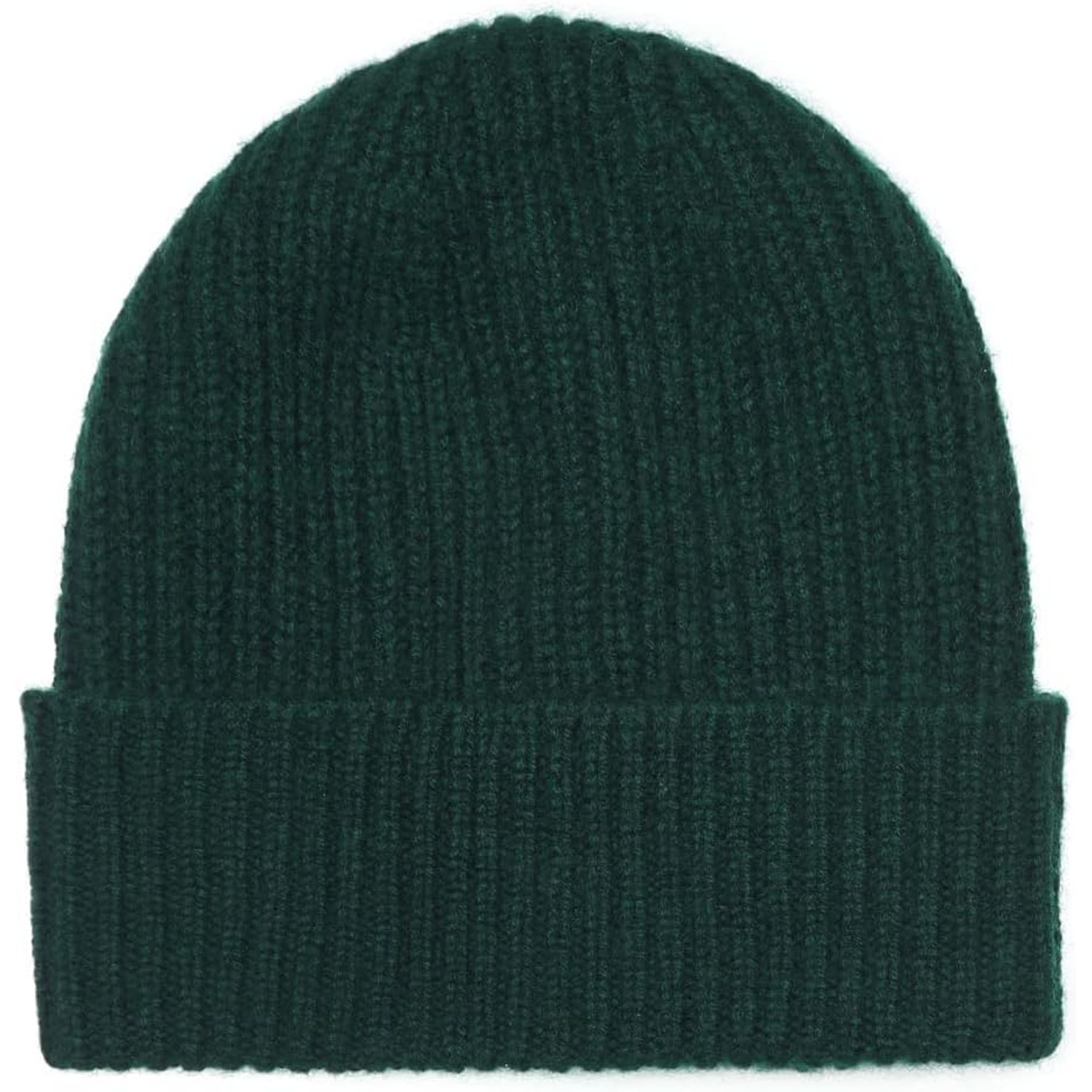
Fit on a beanie comes down to the stretch in the ribbing and the depth of the body. This hat is one size with medium stretch, listed as unisex, with a simple pull-on closure. No drawcords, no fastenings, nothing to adjust.
One size works for most adults precisely because ribbing is elastic by structure. The vertical ribs compress and expand with the head. If you have a larger head, pull the hat on from back to front rather than stretching the band sideways, which is kinder to the knit over time.
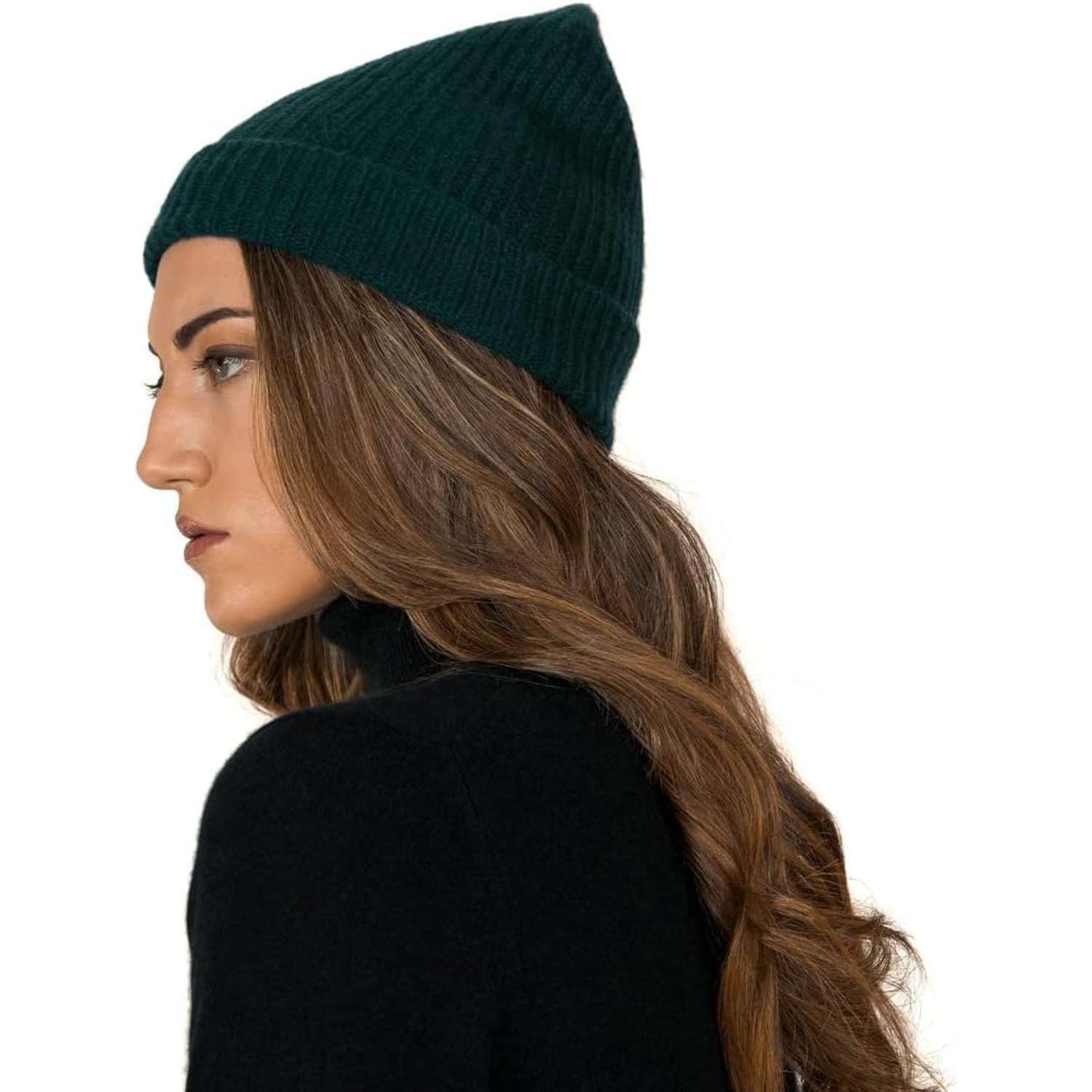
Colour is a quieter decision than it looks. Solid green sits in the same useful place as navy or charcoal. It reads as a neutral against black, grey, camel, denim and most outerwear, but it has more character than plain black. A plain green beanie is easy to wear without looking like you tried.
Think about weight too. The fabric here is described as medium weight. That is a sensible middle ground. Very heavy hats are too much indoors and too bulky to pack. Very light ones look elegant and do nothing when the temperature actually drops.
Looking after it
The care instruction is hand wash or dry clean only. That is not a suggestion with cashmere, it is the difference between a hat that keeps its shape and one that felts into a solid lump.
If you hand wash it, use cool water and a mild wool or cashmere detergent. Let it soak for a few minutes, swirl gently, and resist any urge to rub the fabric against itself. Rubbing plus warmth plus soap is how felting happens. Rinse in water of the same temperature, then press the water out between two towels. Never wring it.
Dry it flat, reshaped, on a towel. Not near a heater, not in direct sun, not in a dryer. It will take a day and it will come back looking like itself.
Between washes, air it. Most of the time a hat does not need washing so much as a few hours hanging in a well-ventilated spot. Wash it at the end of a trip or the end of a season rather than constantly.
For bobbles, buy a cashmere comb or a basic fabric shaver. Lay the hat flat and work in one direction with light pressure. Five minutes brings the surface back. Do this now and then and the surface stays tidy.
Store it folded flat in a drawer rather than hanging it on a hook, which stretches the band. If it is going away for months, make sure it is clean first, because moths are drawn to skin oils and food residue. In a humid climate, make sure it is fully dry before it goes into a sealed box or bag.
A note on value
The temptation with cashmere is to compare the price with a high-street acrylic beanie and conclude it makes no sense. That is the wrong comparison. The better question is how often you will reach for something that feels good to wear.
A pure cashmere three ply knit, cared for properly, is something to keep and reuse. It is also small, so it needs almost no space in a drawer or a bag.
The short version
This is a plain ribbed beanie in 100% cashmere, three ply, made in Scotland, in solid green, one size, unisex, pull-on. Not water resistant. Hand wash or dry clean only.
Three ply is the detail that matters, because it gives the fabric density and spring that a thin single-ply hat never has. Cashmere is the fibre that matters, because it is fine enough to feel soft on the forehead and warm for its weight.
If you work in a cold office, fly often, or have a trip somewhere genuinely cold coming up, this is the kind of thing that lives in your bag and quietly earns its place. Treat it gently when you wash it, comb the bobbles off now and then, and it will keep doing that job.