
The complete guide
How to Choose a Travertine Vanity Tray That Actually Tidies Your Counter
The small mess nobody plans for
Bathroom counters and dressing tables fall apart slowly. One bottle of serum appears, then a hand cream, then a ring you took off while washing up, then a hair tie, then a lip balm that rolled behind the tap. Nothing is dirty. It just looks busy, and a busy counter makes a whole room feel unsettled.
Trays fix this with very little effort on your part. They draw a line around the clutter. Everything inside the line reads as a deliberate arrangement. You do not need to own fewer things. You just need the things to live in one place.
A natural stone vanity tray does that job and earns its place visually too. Stone has weight and texture. In a flat where the surfaces are tile, laminate and painted plaster, a piece of travertine brings a natural material into the room.
What travertine actually is
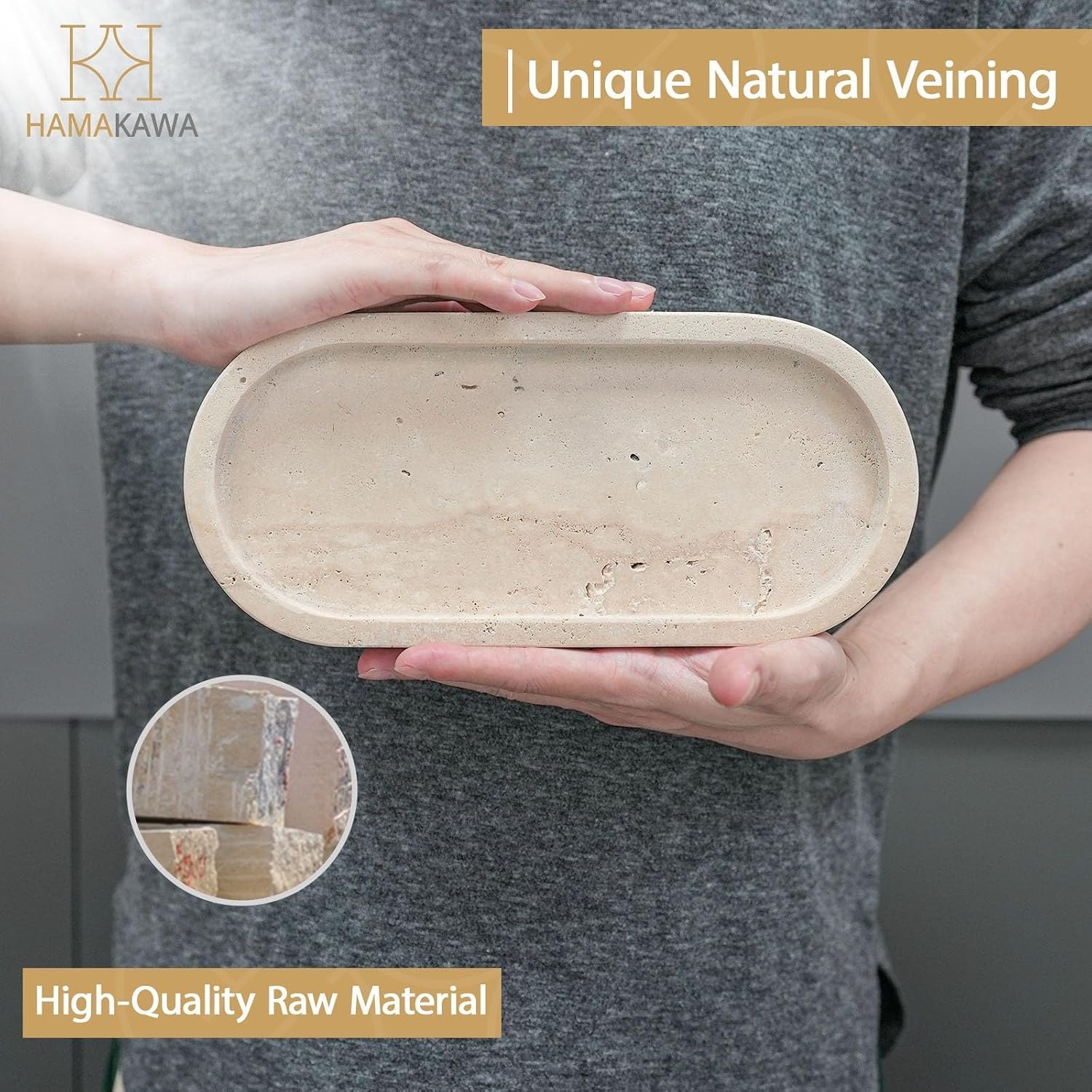
Travertine is a limestone that forms around mineral springs. Water carries dissolved calcium carbonate, it settles in layers over a long time, and gas bubbles escaping through the deposit leave tiny holes behind. That is where travertine gets its two signature traits, the soft banding and the small surface pits.
Sellers often group travertine under the broader heading of marble, and the maker of this tray calls it natural marble as well as natural travertine. Travertine is the more precise word, so that is the one we use.
Travertine tends to be warm in tone. This tray is beige, and that sandy colour sits easily alongside oak, rattan, linen and brass. If your room already has warm notes in it, this stone fits in.
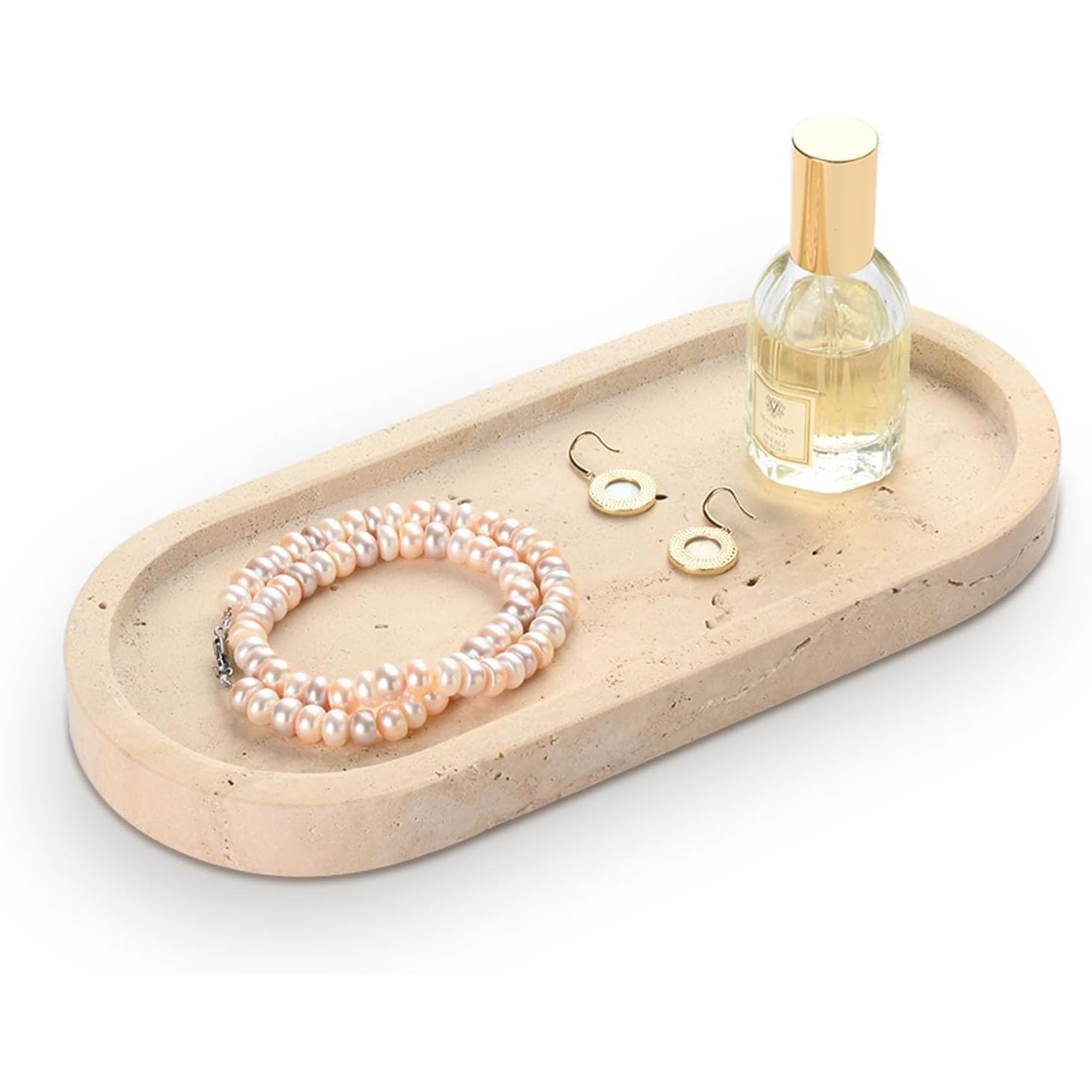
The tiny pits are worth mentioning again, because people new to the stone sometimes think they are damage. They are not. You can see them in the product photos, and the tray you receive will have its own.
Why the long, slim shape matters
Most trays sold for vanities are round or rectangular. Round looks lovely on a wide dresser and awkward on a narrow ledge, because the diameter has to grow in both directions to gain any space. Rectangular fits ledges well but can look severe on a bedside table.
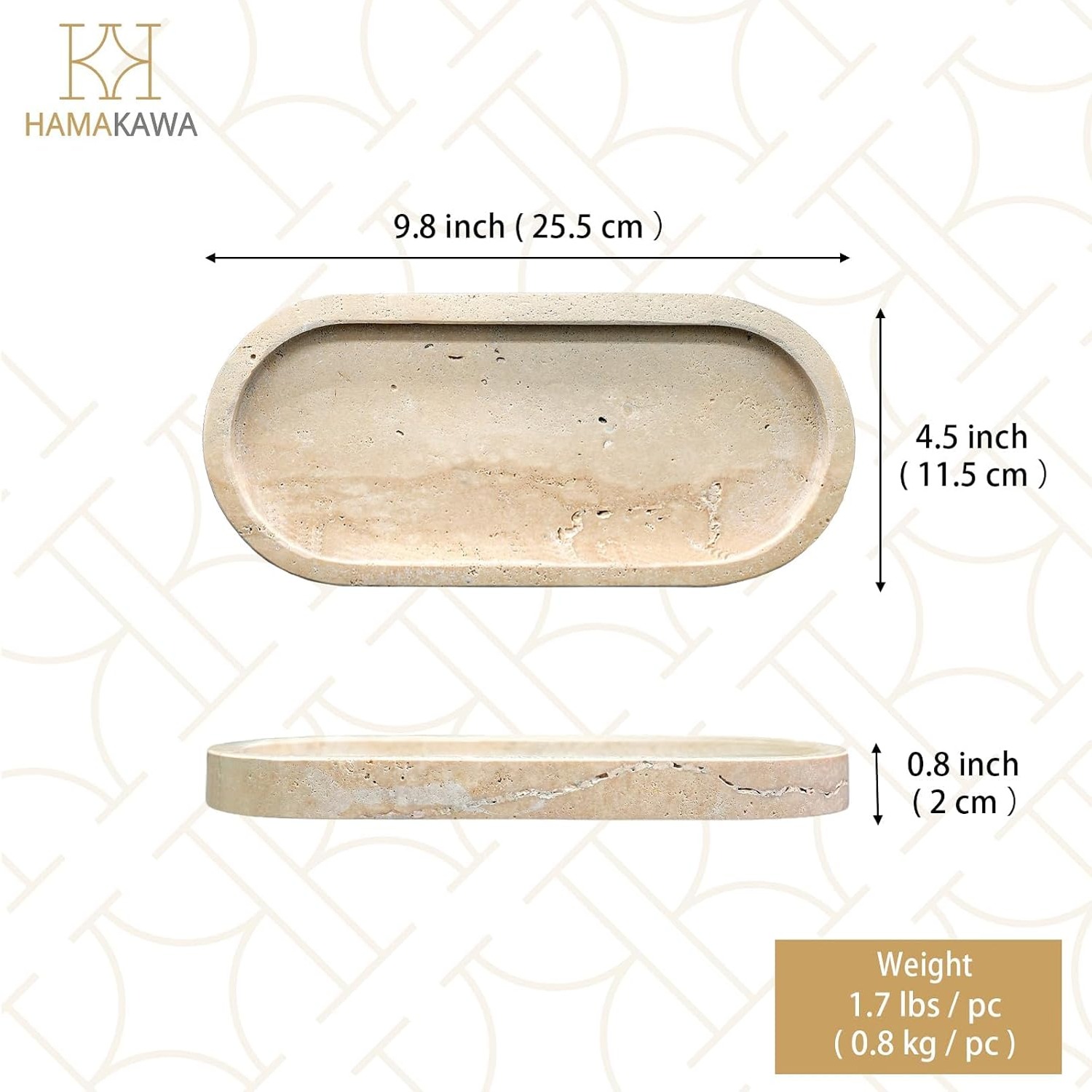
This tray sits between the two. The maker calls it oval. The photos show straight sides with fully rounded ends, like a pill shape. It runs about 25 cm along the long side and only about 11.5 cm across, so it sits along the back edge of a basin ledge or a console without using the whole depth.
Before you order anything, do the boring step. Take a tape measure to the actual spot. Measure from the back wall or splashback to the front edge of the counter, and remember you want a few centimetres of clear space in front of the tray so you are not knocking it every time you reach for the tap. If you have 15 cm of depth, an 11.5 cm tray leaves you some room. If you have 12 cm, look at something slimmer.
Height is the other dimension people forget. The tray is 2 cm high overall, so the rim is low. A low rim lets you see and reach everything, and it keeps tall perfume bottles looking tall. If you want something that hides clutter, you want a box with a lid, not a tray.
Who it suits, and who it does not
This works for anyone whose small daily items currently live scattered. If you wear rings and take them off at the sink, if you own three or four perfumes, if your skincare routine has more than two steps, you will use it every day. It also suits people who want one considered object on a console in place of a cluster of ornaments.
It is an easy gift too. Housewarmings are hard because you do not know anyone's taste in colour, and a neutral stone piece avoids that problem. The maker also lists weddings, Mother's Day and the New Year as occasions for it.
It is not the right pick in a few cases. If you need to carry things from room to room, a tray with handles will serve you better. If you want to hold heavy items, note the 0.8 kg maximum weight recommendation in the listing. This is for small bottles and jewellery, not a stack of books or a full carafe. And if you need two identical trays to look like a matched pair, be aware that natural stone will not match perfectly.
Homes with very young children are worth a thought as well. Stone is hard and heavy for its size. Keep it on a high shelf or a bathroom ledge out of reach, not on a low coffee table.
Choosing between stone trays
Once you start looking you will find stone trays at every price. A few things are worth checking.
Check whether a tray is natural stone or a resin composite with a printed pattern. Composite is lighter and perfectly functional, but the pattern repeats if you look closely. The maker describes this tray as natural travertine and lists the weight at about 0.8 kg.
Look for feet. A flat-bottomed stone tray can drag across a counter and scuff a timber dresser. This one has four small feet, which the maker lists as non-slip and says protect your furniture from wear.
Check the finish. The maker lists this one as polished and says it wipes clean with a damp cloth, which suits a bathroom where you will be wiping it often.
Finally, think about how the piece will age. Stone picks up character. A faint ring where a bottle sat is not a failure. If that idea bothers you, buy something coated and synthetic instead. If it appeals, natural stone is the right material.
Keeping it looking good
Care is simple, but the rules are firm.
Wipe with a soft damp cloth, then dry it. The drying step is the one people skip and it is the one that prevents water marks. For anything sticky, a drop of mild dish soap in warm water does the job.
Avoid acid. That means no vinegar, no bleach, no citrus-based bathroom sprays, no descaler. Acid etches calcium-based stone and leaves a dull patch. Many bathroom cleaners are acidic, so check the label or just stick with soap and water.
Deal with spills quickly. Perfume, nail polish remover, facial toner and oils are the usual culprits on a vanity. Left overnight they can leave a shadow.
The listing says hand wash only, not dishwasher safe and not oven safe. Keep it away from hot pans and direct heat sources.
If you want extra protection, a sealer made for travertine can be applied by following that product's instructions. It is optional for a decorative tray that mostly holds dry items.
Styling it without overthinking
A tray looks good when it is about three-quarters full. Empty, it looks like a mistake. Crammed, it defeats the purpose.
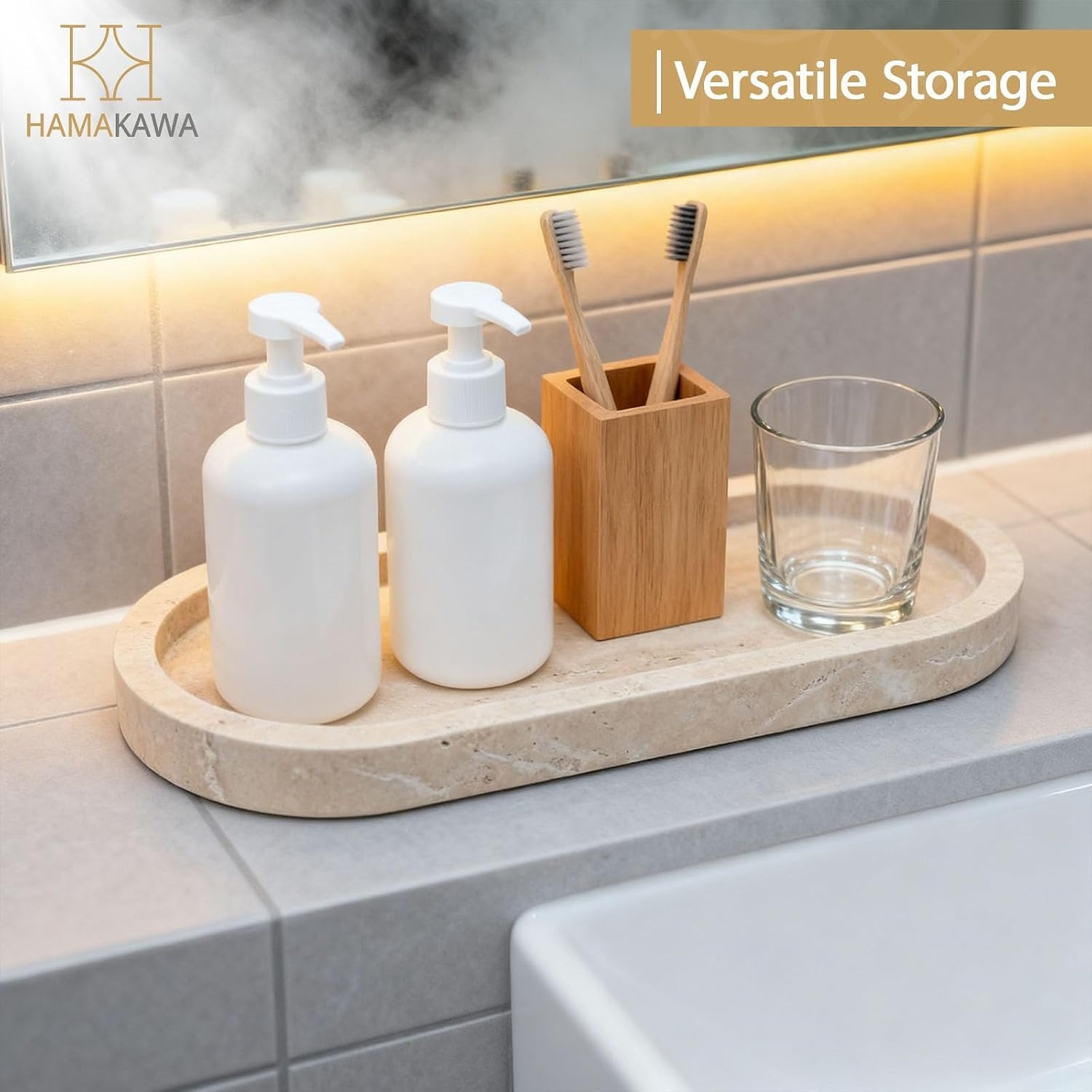
Build around one tall item and work down. A perfume bottle or a slim vase anchors one end, then a mid-height jar or candle, then something flat like a small dish or a folded cloth. Do not agonise over it.
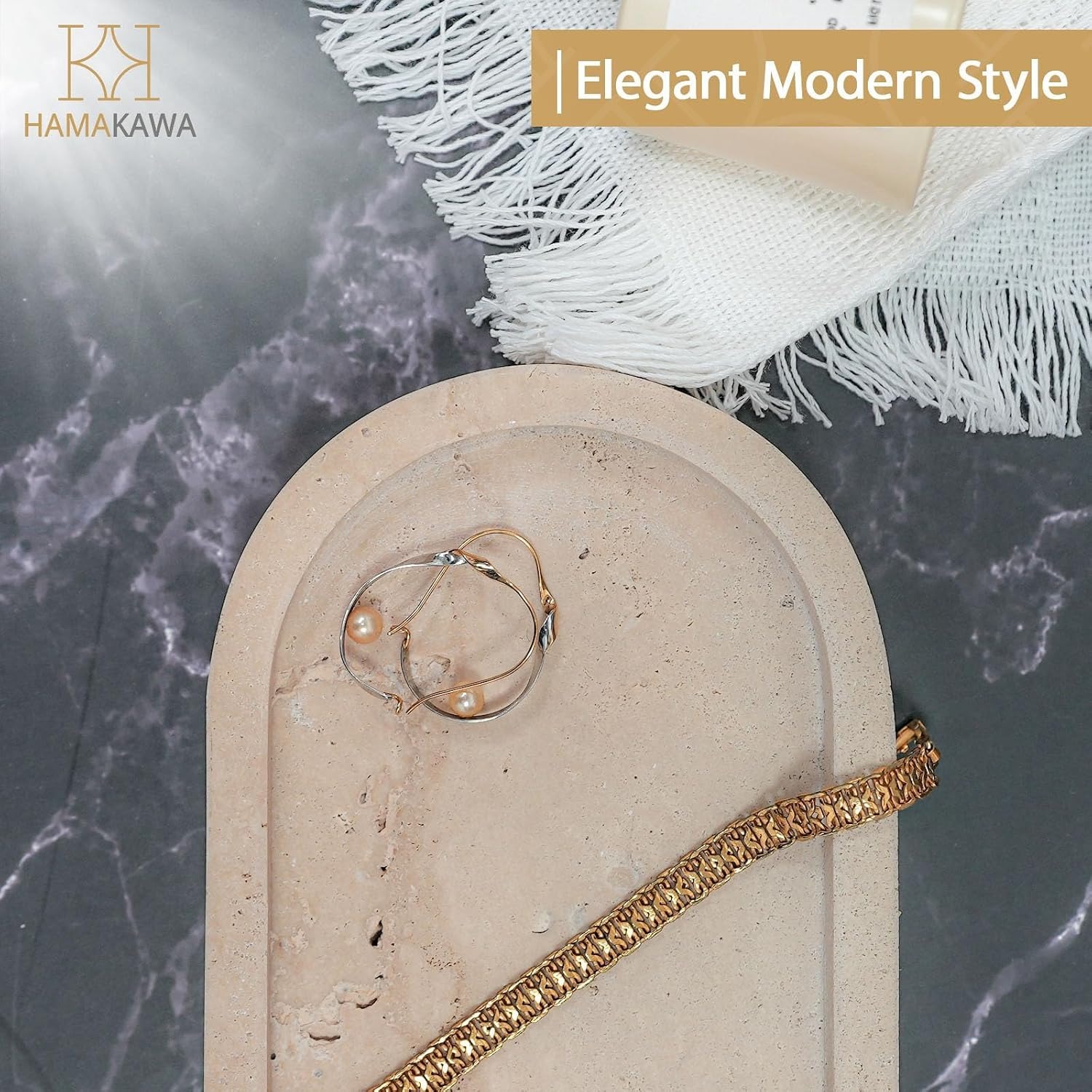
Mixing finishes is where the beige stone earns its keep. Brass, warm gold and aged bronze sit well against travertine. So do clear glass and pale ceramic. If your fittings are chrome or black, the contrast still works. The stone just becomes the warm note in a cool scheme.
In a bedroom, one of these on a bedside table holding a watch, a small candle and your rings is enough. In an entryway, it becomes a catch-all for keys and cards. In a bathroom it goes under the mirror with soap and hand cream.
The short version
This is a beige tray cut from natural travertine, about 25 x 11.5 x 2 cm, weighing about 0.8 kg, with a polished finish and four small feet underneath. The maker calls the shape oval. The listing recommends no more than 0.8 kg on it, so it is for perfume bottles, jewellery, skincare or a candle, kept in one neat zone instead of spread across a counter.
Measure your space first, especially the depth. Expect the veining and tone to be slightly different from the photographs, because the stone is natural. Clean it with a damp cloth and dry it, skip acidic cleaners, and keep it away from heat.